

Fibroids: Are They Really Dangerous?

Discovering you have fibroids can feel like finding a stranger in your own body. The word tumour often strikes a deep fear, making many women feel like they are carrying a ticking time bomb. But what if these growths are not invaders or monsters? As a researcher and womb health expert, I want to invite you to look closer. By understanding the sophisticated biology of fibroids, we can move from fear to empowerment, so rather than seeing them as monsters, you now view them as complex signals of our internal environment.
The ‘C’ Word: Benign vs. Malignant
Clinical research confirms that uterine fibroids are benign smooth muscle tumours. This is critical because so many women are coerced into having a hysterectomy. A critical but highly differential feature that distinguishes a common fibroid from a rare malignancy like leiomyosarcoma is the Pseudocapsule. As a fibroid grows, it creates a distinct boundary. Research shows that the Pseudocapsule is actually a sophisticated neurovascular bundle rich in neurofibres and blood vessels that are pivotal for wound healing and uterine repair. In contrast, cancer tumours lack this organised boundary at the molecular level, which is why it invades surrounding tissue rather than remaining contained. This means fibroids are not cancerous, and having them does not mean you have a higher risk of uterine cancer.
The Hormonal Fuel (It’s Not Just Oestrogen)
While many view oestrogen as the sole culprit for fibroid growth, it is actually a delicate dance between hormones. Fibroids are hyper-estrogenised, but the real expansion occurs through a specific molecular signalling. First, ERα (Oestrogen Receptor alpha) must unlock the cell by inducing the expression of the Progesterone Receptor (PR). It is then the PR that binds to DNA sites to promote cell survival and growth. Oestrogen effectively sets the stage, but progesterone drives cellular growth.
The Mechanical Environment (Why They Feel Hard)
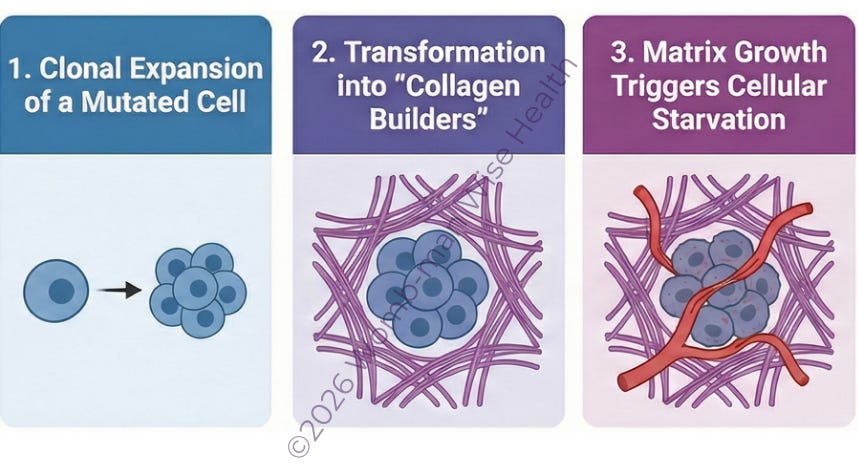
Fibroids are characterised by an excessive deposition of Extracellular Matrix (ECM), a stiff scaffold made of collagen and elastin. This stiffness is a physical conversation between the cell and its scaffold. Through a process called Mechanosensing, fibroid cells feel the mechanical tension of their environment. This creates a vicious cycle of stiffness: the physical pressure of the ECM signals the internal pathways of the cell to keep building, leading to enlargement of the tumours.
The Secret Life Cycle: Fibroids Can Die
It is a common misconception that fibroids only grow. In reality, they have a definitive life cycle and can even undergo a homeotic transformation. Research shows that fibroids are myometrial cells that have switched their biological blueprint to act like cervical stroma tissue (a stiff, fibrous connective tissue that behaves differently). Furthermore, as they build excessive collagen, they can outgrow their nutrient supply. This leads to Inanosis - essentially the cell starving due to lack of nourishment. Once this occurs, the body begins Reclamation, a natural enzymatic process where the dead cells are degraded and recycled. Summing this up simply, fibroids have a natural lifecycle; they can eventually run out of ‘fuel’ and undergo a process where the body begins to recycle the tissue.
The Impact of Environment and Stress
Research has identified that our internal biology reacts strongly to external factors. Clinical studies on phthalates - chemicals found in many consumer products, show an association with a measurable 26.8% to 33.2% increase in uterine volume. Additionally, emotional stress and systemic inflammation create a specific biochemical feed-forward loop. Oestrogen stimulates COX enzymes, which produce PGE2 (prostaglandin E2); which triggers aromatase, the enzyme that makes more oestrogen. This is how stress and inflammation can physically fuel the growth of fibroid tissue.
While fibroids can impact quality of life through symptoms like anaemia or pain, the clinical reality is that they are manageable, benign entities. By understanding the protective Pseudocapsule, the vicious cycle of Mechanosensing, and the natural stages of starvation, we can release any fear, because you now know that fibroids are part of a complex biological narrative.
If you start viewing fibroids as a signal from your body’s internal environment rather than an enemy to be feared, how will that change the way you approach your healing journey?
If this resonated, here are two powerful articles to explore next:
This space is where I teach the deeper truths about fibroids, womb health, and feminine healing: the things women are never told. Stay connected as I continue to share the frameworks, insights, and root‑cause teachings that shape my private work.