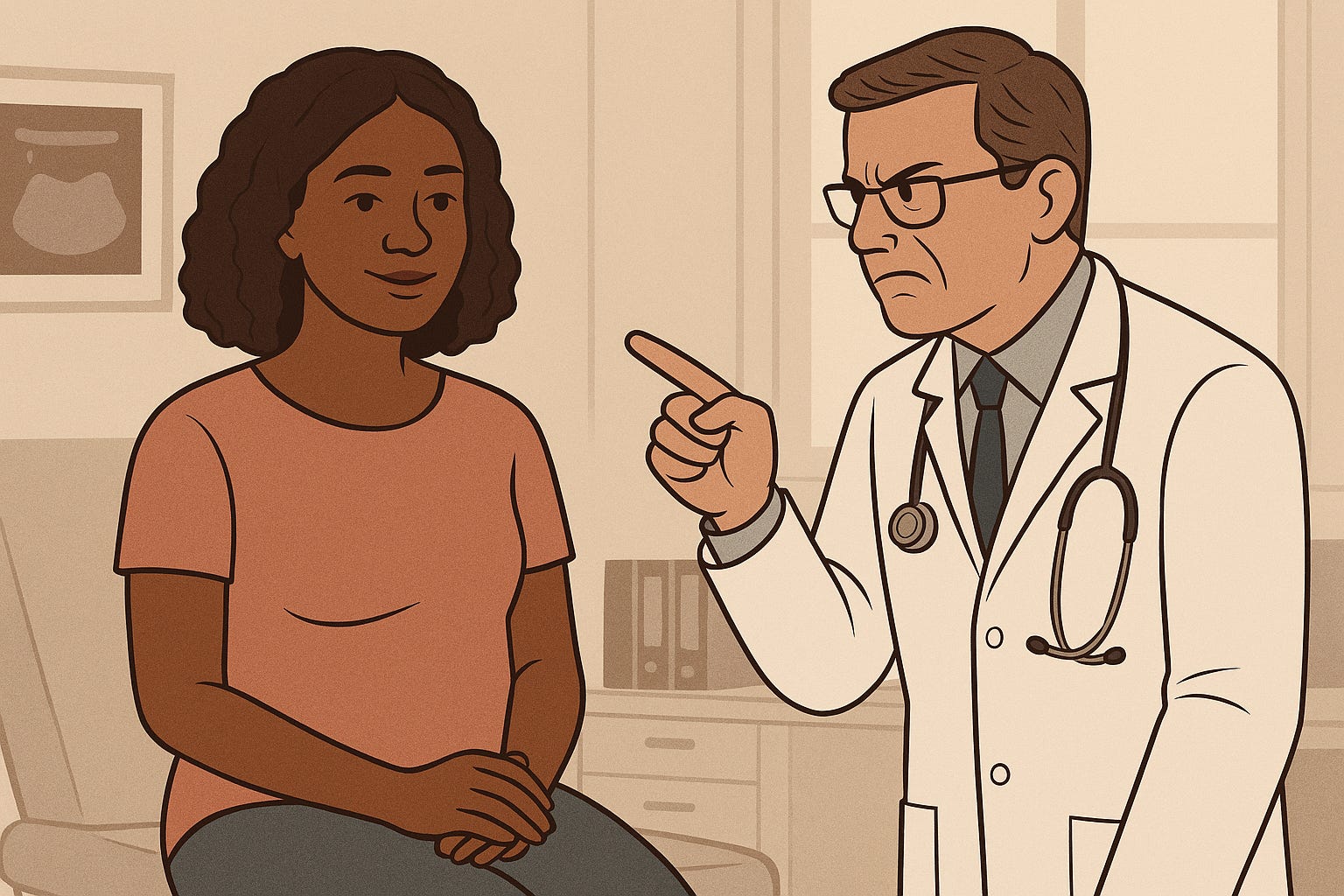
For the Woman Who Said No to Surgery

You’re sitting in the doctor’s office. The ultrasound results are in. You have large, multiple fibroids. A belly that looks six months pregnant. Pain that radiates down your legs. Frequent urination that wakes you multiple times a night, and bleeding so heavy it leaves you exhausted. And then you hear it: You need surgery.
Initially, the very word sends a shock wave through your spine and something inside you wants to panic, but almost immediately a calm descends over your body and your mind says: No.
You’ve been told that surgery is your only option, but every fibre of your being is telling you there is another way, even though you have no idea how you’ll move forward.
The Difference Between Fear and Knowing
There is a massive difference between fear-based resistance and intuitive refusal, and learning to distinguish between the two is critical.
Fear says: I’m terrified of surgery. What if something goes wrong? What if I can’t recover? What if I don’t wake up?
Fear is rooted in worst‑case scenarios, past trauma, or stories you’ve heard from other women. It makes your chest tight, your mind race, and your body tense. It’s reactive, urgent, and often accompanied by a desperate search for reassurance.
Intuition, on the other hand, is different. Intuition says: This isn’t my path. There’s another way, even if I don’t know what it is yet.
You’re calm. You don’t argue with the doctor or justify yourself with logic. You don’t need to convince anyone. You just know. And that knowing sits in your body like an anchor. You might not be able to explain it to anyone, let alone yourself. But you feel it. And it won’t go away.
Unfortunately, most of us have been trained to override our inner voice. We’ve been taught that our bodies are unreliable, that our instincts are irrational, and that the experts know better. We’ve been conditioned to distrust ourselves - to believe that if we can’t explain something logically, it must not be valid.
So when that inner knowing arises, you second‑guess it. You dismiss it. You tell yourself you’re being foolish, irresponsible, or scared. But what if you’re not? What if that inner no is the most intelligent thing your body has ever said to you?
The Grief of Being Told Your Only Option Is Removal
There’s a particular kind of grief that comes with being told your only option is to remove part of yourself. For you, your womb might represent fertility, femininity, and future. Even if you’re done having children. Even if you’re in pain. Even if, logically, you understand why surgery might make sense - there’s still a mourning that happens when you’re told: “You don’t need it.”
And beneath that grief is often a deeper, more painful question: Why did my body betray me?
You’ve spent years trying to manage symptoms, trying to be healthy, trying to do the right things. And yet here you are, being told that your body has failed you. That it produced something harmful and that the only solution is to remove it. It’s hard not to feel betrayed. It’s hard not to feel like your body is the enemy.
But what if it didn’t betray you? What if your body has been trying to tell you something, and fibroids are just the loudest way it knows how? What if your fibroids are messengers? What if they’re saying: Something here needs to change. Something in your life, habits, or environment is out of balance, and I need you to pay attention.
When you start to see fibroids this way, everything shifts. Your grief transforms because you’re beginning to understand what’s possible.
The Pressure to Be Sensible
Your decision not to have surgery will usually be met with disapproval and predictable responses such as:
“But you’re in so much pain.”
“It’s the safest option.”
“You’ll feel so much better afterward.”
“Don’t let fear stop you from getting the help you need.”
But the unspoken message beneath it all is: Be sensible. I’m the expert. Do what you’re told.
There’s a subtle but powerful pressure to comply - not just from doctors, but from well‑meaning friends, family, and even other women who’ve had surgery and found relief. They want the best for you. They don’t want you to suffer. And in their minds, surgery is the only answer.
So when you hesitate, it’s met with confusion, frustration, and more often than not—judgment. You’re labeled as difficult or unrealistic. And the worst part is being told you’re being irresponsible. The pressure to conform is real.
But choosing to listen to your inner no, even when everyone around you is saying yes, is one of the bravest things you can do. It takes courage to stand in the face of medical authority and say, “I hear you, but this doesn’t feel right for me.”
It takes strength to trust yourself when no one else does. It takes faith to believe there’s another way, even when you can’t see it yet. And it takes a deep, unshakable knowing that you are not being foolish - you are being faithful to something inside you that matters more than approval or expectations.
The Moment Everything Shifts
There’s a moment when a woman realises: I don’t want this future. Even if it sounds easier.
She sees the path ahead clearly. Surgery. Recovery. Maybe relief. Maybe not.
Something in you says: This isn’t what I want. And in that moment, you make a choice.
You want to know: What if there’s another way? What if I’m not meant to cut this part of me out? Rather than simply removing your womb, you want to understand why your fibroids grew in the first place.
This is the moment where, according to conventional rules, you become a “difficult” patient, because you are no longer waiting for someone to fix you. You want to be an active participant in your own healing. What you are really asking is:
“What is my body trying to tell me? And what do I need in order to understand it?”
Rather than: “What’s wrong with me?”
Surgery Isn’t Wrong. But Neither Is Choosing Not To.
Surgery is not wrong. For many, it’s the right choice. If you are considering surgery, you’re doing so because you’ve had enough. Surgery can bring relief. It can close a chapter and allow you to move forward. And that’s absolutely okay.
But so is choosing not to.
Choosing to explore other options.
Wanting to know the root cause.
Choosing to heal from the inside out.
That’s okay too. In fact, it’s powerful, and it deserves respect.
There is nothing wrong with surgery. The problem is the belief that it’s the only option. The problem is a medical system that treats fibroids as isolated growths rather than symptoms of deeper imbalances.
You are allowed to choose differently.
You are allowed to say, “I want to understand why this happened before I decide what to do about it.”
You are allowed to honour that inner no, even if no one else understands it.
Because this is your body, and only you get to decide what happens next.
Not Every Woman Is Meant to Walk the Same Path
Some women are here to close a chapter. Others are here to rewrite their story.
If you’re reading this and something in you is stirring… if you feel that inner no and you’re finally ready to honour it, you’re not alone. You’re not crazy, irresponsible, or in denial.
You are a woman who knows, deep down, that there’s more to this than what you’ve been told. And you would be right. Fibroids are your body’s way of saying: Something needs to change. Not just physically, but emotionally, mentally, and spiritually too.
And when you’re ready to listen, really listen, that’s when the real healing begins.
And no, this is not an easy path. It requires you to question everything you’ve been told about your body. It requires deep work. Balancing hormones and changing your diet is helpful, but it’s not enough. Fibroids require a major shift within. They require you to become a different woman, because the woman you’ve been is the one your fibroids grew in. And the woman you’re becoming is the one they no longer need.
Where to Start
If you’re the woman who said no, this is what I want you to know:
You don’t have to have all the answers right now.
You don’t have to know the exact protocol or eat the perfect diet.
You just have to start listening.
Start asking yourself:
What is my body trying to tell me?
What conditions allowed these fibroids to grow in the first place?
Who do I need to become so they no longer have a reason to stay?
Notice how these questions are different from:
What do I need to take? What should I eat? What herbs worked for you?
Dealing with fibroids is deep work. It’s not a quick fix and never will be. There is no magic pill. It’s not a 30‑day detox or a handful of supplements. It requires a transformation of your body, your beliefs, and your relationship with yourself.
If this resonates with you, if you’re ready to explore the path beyond surgery, welcome. You are in the right place.