

The Command Centre of the Womb
Nervous System Regulation and the Uterine Environment

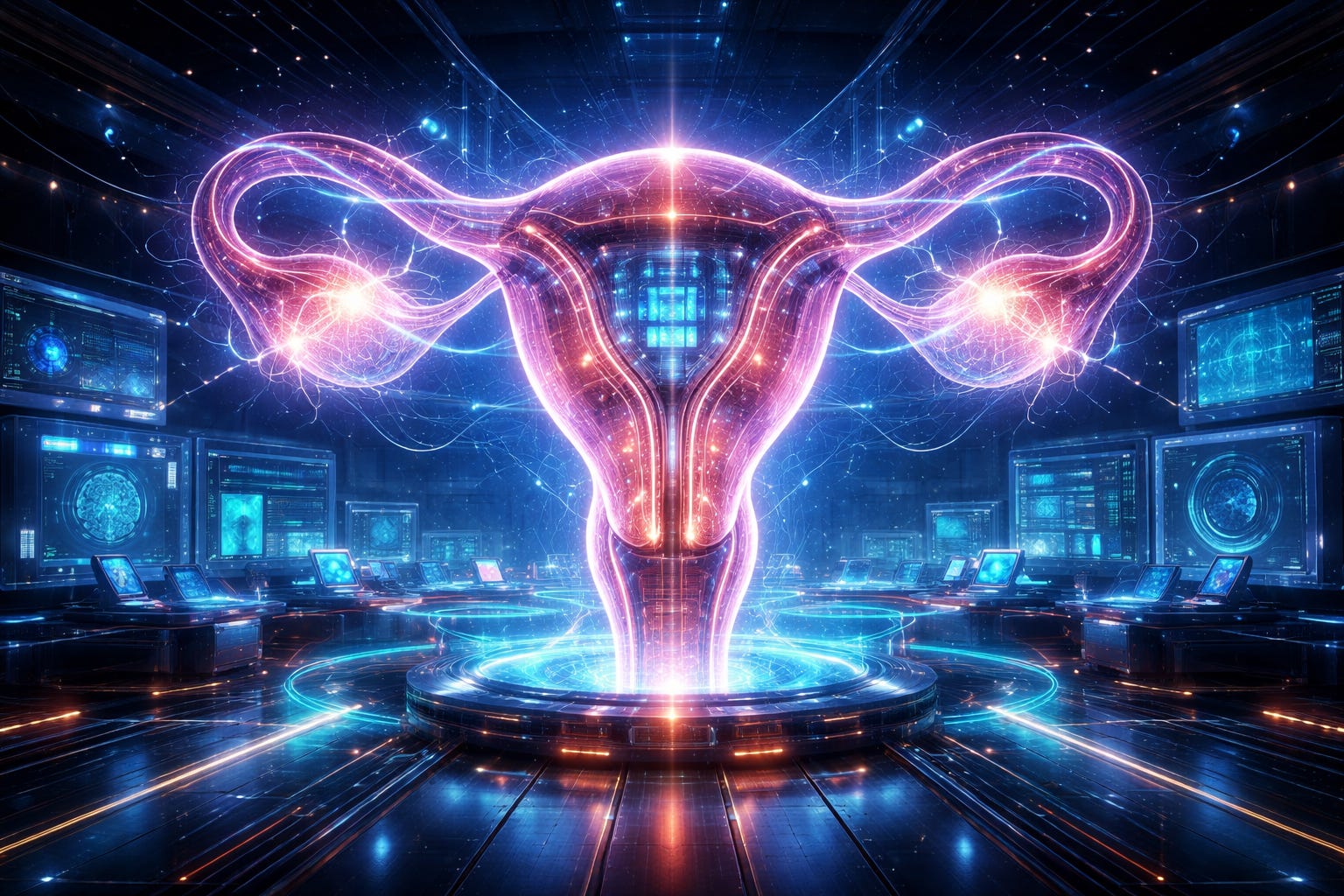
Most conventional medicine treats uterine fibroids like nothing more than isolated growths that must be surgically removed and that is about it. But this rather blinkered view misses something quite profound. To truly understand fibroids, we need to see the uterus for what it really is: a Command Centre - an organ that is connected to the nervous system, the opiate receptor system, and the brain’s response to living under conditions of chronic threat and oppression.
Uterine health is a whole-body, whole-life phenomenon. For example, when the environment you dwell in is experienced as a system of total oppression, the uterus reflects that lack of safety through pathological changes.
Your uterus is a highly sensitive site of constant remodelling and repair. Think of it as a biological mirror that reflects your internal and external world, shaped by whether your brain perceives the environment as safe or threatening.
The Autonomic Nervous System and Cellular Terrain
Your autonomic nervous system (ANS) is essentially the translator between your environment and your biology. It takes in the stressors around you and converts them into biological signals that shape your reproductive health. Under conditions of chronic oppression, the HPA (Hypothalamic-Pituitary-Adrenal) axis [your body’s central stress-response system] can become dysregulated. When that happens, the brain gets stuck in a permanent state of defence, and it’s your womb that pays the price.
This plays out across three key areas:
Blood Flow: When the body perceives chronic threat, it constricts blood vessels and redirects flow to survival-priority sites, meaning the uterus misses out on the rich, nourishing blood supply it needs to stay healthy.
Inflammation: The ANS sets the body’s inflammatory baseline. Under sustained oppression, that baseline stays elevated, and a chronically inflamed uterine environment signals the body to keep building protective tissue.
Hormonal Balance: A healthy HPA axis is the foundation of hormonal harmony. When it’s dysregulated, oestrogen receptors can become overexpressed, essentially priming the uterus for abnormal cell growth.
The Opiate Receptor and Pain Circuitry
It’s understood that the reproductive architecture [as in the design of the reproductive system in terms of sensitivity, responsiveness and regulation] is piggybacked onto the brain’s ancient pain circuitry - the midbrain and brain stem. The opiate receptor system, the body’s natural regulator of pain and homeostasis, lives right here. This means your uterus is literally listening to the same signals that report environmental danger.
When a woman experiences the social pain of alienation, the threat of erasure within a hostile system, her opiate receptors become sensitised. That heightened reactivity changes the signalling environment of the uterine muscle, effectively transforming social and emotional pain into physical, defensive growth.
Stress-Induced Pathology: Cortisol, DHEA-S, and Fibroid Growth
Chronic stress shifts the balance between cortisol and DHEA-S, creating a biological environment that encourages fibroid growth. This hormonal imbalance is often driven by what can be called circular thought patterns: the brain keeps perceiving a problem, but the social structure denies that there is anything wrong, so the mind loops, the body stays on high alert, and the uterus bears the burden.
The Psychogenetic Environment: Alienation, Anxiety, and Systemic Threat
Uterine health is also shaped by what we might call the psychogenetic environment: the psychological and social conditions a woman lives within.
Let’s take the Isis Papers by Frances Cress Welsing as an example. She speaks about the global system of white supremacy that functions as a behavioural power system built around white genetic survival. For non-white women, this creates a deep state of alienation, a fracture between the conscious and unconscious self, and a disconnection from one’s own body and identity. When a woman is conditioned to identify with the oppressor, or to see her own powerful genetic potential as “inferior”, that self-alienation creates a cellular mismatch. The brain registers a systemic threat to its genetic integrity and stays locked in a pro-inflammatory state, prioritising the fortification of the uterus over its healing.
Uterine Peace is what becomes possible when the brain finally decodes its environment as safe. Without that safety signal, physical healing is undermined by the subconscious drive for defensive growth.
Managing the Mechanical Wear-and-Tear of Modernity
Healing asks something of us on two levels at once: managing the physical symptoms whilst actively practising what we might call counter-racist behaviours — the daily work of nervous system regulation and HPA axis restoration.
Shifting from Circular to Linear Thought: Restoring HPA axis health begins with moving out of repetitive, circular worry and into purposeful, solution-focused thinking. The brain evolved to solve problems - not to spin endlessly in them. Reclaiming that function is itself an act of healing.
Neutralising Harmful Symbolism: This means learning to decode the symbols and messages that keep the brain in a state of perceived threat. Understanding how certain [oppressive] systems operate allows you to interrupt the logic short-circuiting that keeps your body in physiological alarm.
Restoring a Sense of Environmental Safety: This involves healing the alienation from your own genetic identity - actively rejecting the narrative that your genetic potential is inferior or marginal. When the Command Centre no longer perceives a threat to your fundamental integrity, it can finally stand down from the order for defensive cellular fortification.
The Path to Reproductive Homeostasis
Your uterus is a sensitive, intelligent organ woven into a complex web of neurology, psychology, and lived experience. When the environment feels like a reign of terror, when survival feels under constant threat, your uterus responds by building defences. Your body is doing exactly what it was designed to do.
But true healing asks for far more than just surgery. It is asking for safety. Reproductive homeostasis [balance] becomes possible only when the Command Centre can finally register that the environment as safe, and release the order for defensive growth.
If you enjoyed reading this, you’ll love these:
Why Fibroids Hit Black Women Harder
This space is where I teach the real truths about fibroids, womb health, and healing: the things women are never told. Stay connected as I continue to share the frameworks, insights, and root‑cause teachings that shape my work.
References
Afrin, S., Islam, M. S., Patzkowsky, K., & Al-Hendy, A. (2020). Simvastatin ameliorates altered mechanotransduction in uterine leiomyoma cells. American Journal of Obstetrics and Gynaecology, 223(5), 733.e1–733.e14.
Amin, T. N., Wong, M., Foo, X., Pointer, S. L., Goodhart, V., & Jurkovic, D. (2021). The effect of pelvic pathology on uterine vein diameters. The Journal of Medical Ultrasonics, 13(1), 7.
Fathalla, M. F. (2018). Impact of reproductive evolutionary mismatch on women’s health and the need for action and research. International Journal of Gynaecology & Obstetrics, 144(2), 129–134.
Guilliams, T. G. (2010). Chronic stress and the HPA axis: Clinical implications for the use of nutraceuticals. The Standard, 9(2), 1–14.
Jarrell, J. F. (2016). Evolutionary considerations in the development of chronic pelvic pain. Journal of Obstetrics and Gynaecology Canada, 38(6), 546–551.
Leppert, P. C., Al-Hendy, A., Baird, D. D., Bulun, S., Catherino, W., Dixon, D., & Stewart, E. A. (2020). Summary of the proceedings of the Basic Science of Uterine Fibroids meeting: New developments (February 28, 2020). Fertility and Sterility, 115(1), 12–23.
Liu, S., Yin, P., Xu, J., Dotts, A. J., Kujawa, S. A., & Coon, V., J. S. (2020). Targeting DNA methylation depletes uterine leiomyoma stem cell–enriched population by stimulating their differentiation. Endocrinology, 161(10), bqaa143.
Redfern, R. (n.d.). Improving endometriosis and fibroids in 30 days: Rehabilitation plan for long-term health.
Yang, Q., Ciebiera, M., Bariani, M. V., Ali, M., Elkafas, H., Boyer, T. G., & Al-Hendy, A. (2022). Comprehensive review of uterine fibroids: Developmental origin, pathogenesis, and treatment. Endocrine Reviews, 43(4), 678–719.
Włodarczyk, M., Nowicka, G., Ali, M., Yang, Q., & Al-Hendy, A. (2022). Epigenetic regulation in uterine fibroids—The role of ten-eleven translocation enzymes and their potential therapeutic application. International Journal of Molecular Sciences, 23(5), 2720.