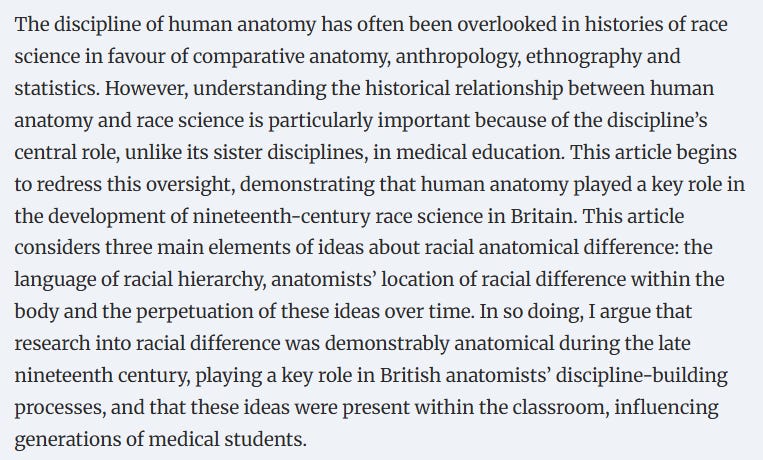
Between 1860 and 1910, British medical education underwent a quiet yet profound transformation: the white, male body was established as the “universal” model of human anatomy. This shift was not accidental but the result of race science, which placed human anatomy at the centre of a project to legitimise racial hierarchies.
Prominent anatomists such as John Goodsir and George Dancer Thane explicitly framed racial difference as anatomical. They presented non-white populations as regressed or less evolved versions of humanity, positioning the white body at the top of an imagined evolutionary ladder. Thane’s meticulous classifications of hair type, skin tone, facial features, stature, and body proportions demonstrate how systematically these ideas were taught within British universities.
This framework was woven into the very fabric of medical education. In textbooks like Alexander Macalister’s A Textbook of Human Anatomy (1889), whiteness was portrayed as the ideal, while the bodies of women and people of colour were labelled as deviations or abnormalities. Though such texts claimed only to record the unusual, they embedded a vision of normality that centred exclusively on white, male bodies.
The dissection room reinforced this hierarchy. Non-white cadavers were explicitly marked and treated as distinct, while white male bodies were taken as the unspoken standard. Through both language and practice, medical teaching enshrined whiteness as the default, with all other bodies rendered variations from the norm.
The legacy of this historical normalisation remains visible. A 2008 study analysing over 16,000 images from anatomy textbooks across leading universities found that depictions of the human body overwhelmingly featured white, heterosexual men. This enduring dominance highlights how deeply the “white norm” is institutionalised in medical discourse, shaping not only how medicine is taught but also how it is practised today.
By naturalising whiteness as the anatomical standard, nineteenth and early twentieth-century medical education helped entrench a hierarchy whose effects continue to reverberate in clinical practice, medical imagery, and patient care.
Reference
Molina, A. (2021). The New (White) Normal: Human Anatomy and the Naturalisation of White Bodies in British University Teaching, 1860–1910. Social History of Medicine, 34(4), 1314–1339. https://doi.org/10.1093/shm/hkab002