The Oestrogen Domino Effect: How Metabolism Matters More Than Levels
Why high oestrogen is a red herring, and how your liver’s metabolic choices actually drive fibroid growth

The Myth of High Oestrogen
I hear a familiar story whilst consulting with women who are exhausted by their struggle with fibroids [benign smooth muscle tumours, also known as neoplasms]. They tell me they have done everything, yet, their tumours continue to grow, while the heavy bleeding feels like someone turned the tap on full and it got stuck there.
The Common Narrative, or the outer vision most of us are given, suggests that fibroids are simply the result of too much oestrogen, but if you have tried everything and nothing changes - that is a big problem. Hearing this over and over again and experiencing this for myself, left me with a sense of unease. It didn’t sit right with me. So when I started looking into what the research actually shows, I found myself down a rabbit hole I didn’t expect. The typical medical explanation wasn’t matching what I was seeing. The biochemical reality of fibroids being just an oestrogen problem is a red herring.
What is rarely discussed is how your liver chooses to metabolise [the biochemical process of breaking down and transforming substances] the hormones you already have. When you focus on pathways rather than just levels, you stop viewing your body as a mindless machine and start seeing it as an intelligent, communicative network.
The Liver’s Metabolic Crossroads
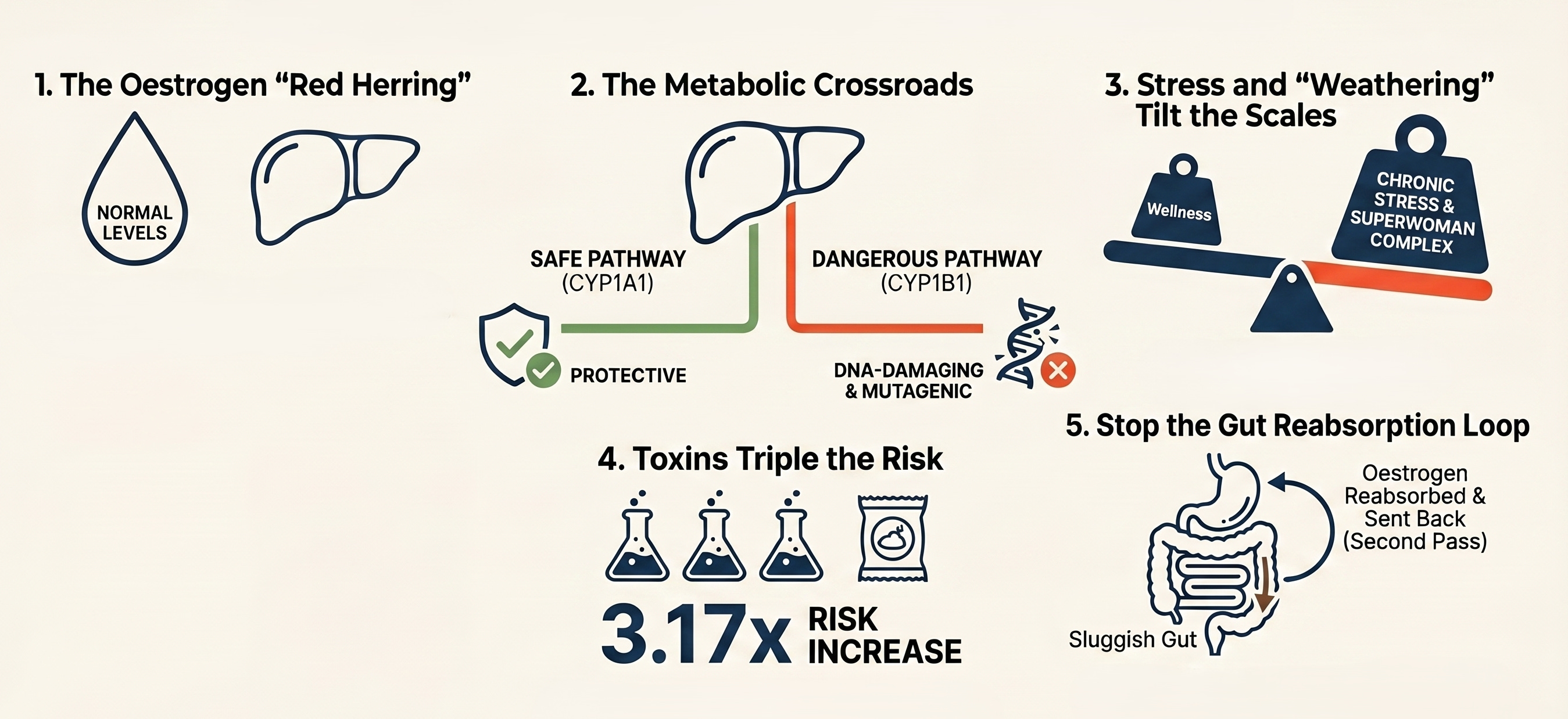
Now… imagine your liver as a sophisticated metabolic factory that transforms oestrogen into different metabolites [substances formed during the metabolic process]. At this point, your liver chooses between two distinct pathways based on the resources it has available:
The Safe Pathway (CYP1A1): This route produces 2-hydroxyestrone. Research calls this the Good Metabolite because it’s safe and protective, hormones are easily cleared and it does not stimulate abnormal tissue growth.
The Dangerous Pathway (CYP1B1): This route produces 4-hydroxyestrone. This is the Bad Metabolite, which is the toxic, DNA-damaging, and mutagenic [capable of causing genetic mutations] pathway.
This explains why you can have normal oestrogen levels on a blood test but still suffer from oestrogen overload. If your liver prioritises the CYP1B1 pathway, your system is flooded with mutagenic signals that encourage fibroid growth, regardless of the total amount of hormone present.
What Tips the Balance?
The shift toward the Dangerous Pathway is mainly down to a biological adaptation to the chronic loads many of us have on our systems. Several factors tilt the scales:
Stress and Hypertension: Chronic stress keeps cortisol levels high, which steals the metabolic resources needed for safe detoxification. There is a staggering connection with hypertension [high blood pressure], which is associated with an almost fivefold increased risk of fibroids.
The Weathering Connection: For Black women in particular, the risk of developing fibroids is two to three times higher than for white women. Through my research, I came across a term known as Weathering, which is the biological erosion caused by chronic stress and the Superwoman complex. This is a survival adaptation where your body prioritises immediate stress-response over long-term hormonal balance. No matter how much someone else might not see it, weathering is real and has a major impact on your body.
Toxins and Food Additives: Exposure to food additives in processed or preserved foods increases risk by 3.17 times. These act as xenoestrogens [synthetic or environmental chemicals that mimic oestrogen], forcing your liver to prioritise emergency detoxification over safe oestrogen processing.
Age and Gut Health: Age is the most significant demographic factor; women aged 41–60 are 10 times more likely to have fibroids than those in their 20s. Further, if your gut is sluggish, oestrogen is reabsorbed and sent back to the liver, where it is often forced through the dangerous pathway a second time.
The Fibroid Connection: Why This Matters
Imagine your uterus as a sensitive node in a body-wide network. As Dr Candace Pert explored in her work, Molecules of Emotion, our bodies are a mobile brain where information is carried by neuropeptides [protein-based chemical messengers that carry information between cells].
When your liver favours the CYP1B1 pathway, the 4-hydroxyestrone acts as a ligand [a molecule that binds specifically to a receptor to trigger a response]. This specific ligand docks onto the receptors of the uterine smooth muscle, delivering a potent grow signal to the fibroids. The tissue therefore is doing nothing more than simply responding to the biochemical information it has been given. That is its design.
The Domino Effect
Your Liver is overwhelmed by stress, xenoestrogens, or hypertension etc.
The CYP1B1 pathway is activated as an emergency metabolic route.
Toxic metabolites (4-hydroxyestrone) are produced, creating a DNA-damaging environment.
Fibroid tissue receives a continuous grow signal via the body-wide information network.
Symptoms worsen, resulting in anaemia from heavy bleeding, bloating, and pelvic pain.
Actionable Steps for the Way Forward
Your goal is not to try and suppress oestrogen, which you need for bone and brain health, but rather shifting the balance back toward the safe CYP1A1 pathway.
Targeted Nutrition: Support the safe pathway with cruciferous vegetables (broccoli, kale, Brussels sprouts). These foods contain DIM and I3C, the molecular tools that nudge the liver toward the protective 2-hydroxyestrone route.
Liver Support as Fuel: The CYP1A1 pathway is actually quite expensive for your body to run. You can mitigate this by giving your body the fuel it requires, specifically Magnesium and B-vitamins, whilst maintaining consistent hydration to ensure metabolites are moved out of the system efficiently.
Managing the Load: Reducing exposure to processed foods, food additives and addressing hypertension through stress management can stop the emergency metabolic shift that triggers the bad pathway effect.
Empowerment You Through Understanding
For far too long, women have been told that their fibroids are a matter of bad luck or bad genes and there is nothing you can do. But we now know otherwise. You are not a victim of your hormone levels.
By understanding your metabolic environment and how your liver processes these molecules, you can begin to listen to what your body is telling you. When you support the liver’s safe metabolic pathway, you take back control from the growth signal and move toward a state of balance.
Do you know what is happening internally? Is it metabolic, cellular, environmental? Undoing this is not a quick fix. It involves a complete system reset.
I’m always examining the root causes of fibroid recurrence, and I want to make sure I’m focusing on the exact transformation that matters most to women like you.
If you could wave a magic wand and change one thing about your journey with fibroids, beyond just the physical symptoms that is, what would it be?
Is it the fear of surgery? The exhaustion? The feeling of not being heard by doctors?
I’m not selling anything. I’m just gathering insights to ensure I’m building the right support for the women who need it most, and your input is incredibly valuable.
Take the 1-minute survey here.
(This is anonymous. No commitment required - just your honest feedback.)
Thank you for being part of the Beyond Fibroids Sisterhood.