Why Hurt People Hurt People
And How it Shows Up in the Body

We use the phrase “hurt people hurt people” like it’s moral shorthand. When someone lashes out, gossips, or polices another person’s space, underlying that behaviour is a survival strategy; a strategy learned from living in an ‘unsafe’ environment. Over time these survival strategies re-signify the nervous system, re-pattern behaviour, and crucially... show up in the body as chronic health problems.
Trauma reconfigures how the brain and body register safety. Bessel van der Kolk showed how traumatic experiences change attention, bodily sensation, and even the capacity to rest in a safe state. Trauma rewires the thresholds of threat so that small triggers produce large physiological responses; this is how psychological injury becomes somatic.
Dr Gabor Maté’s work makes this painfully practical: when people suppress emotions or trade authenticity for survival, the body “says no.” Chronic repression alters immune function, inflammatory signalling and hormonal balance: the same pathways medicine now links with many chronic illnesses. Maté frames disease as the final common path of sustained survival strategies.
Science gives us the plumbing: psychoneuroimmunology (PNI) maps how the brain, nervous system and immune system talk to each other. Chronic stress flattens immune flexibility, nudges inflammation upward and changes tissue repair dynamics. These are measurable biological processes implicated in autoimmunity, metabolic disorders, and reproductive pathology.
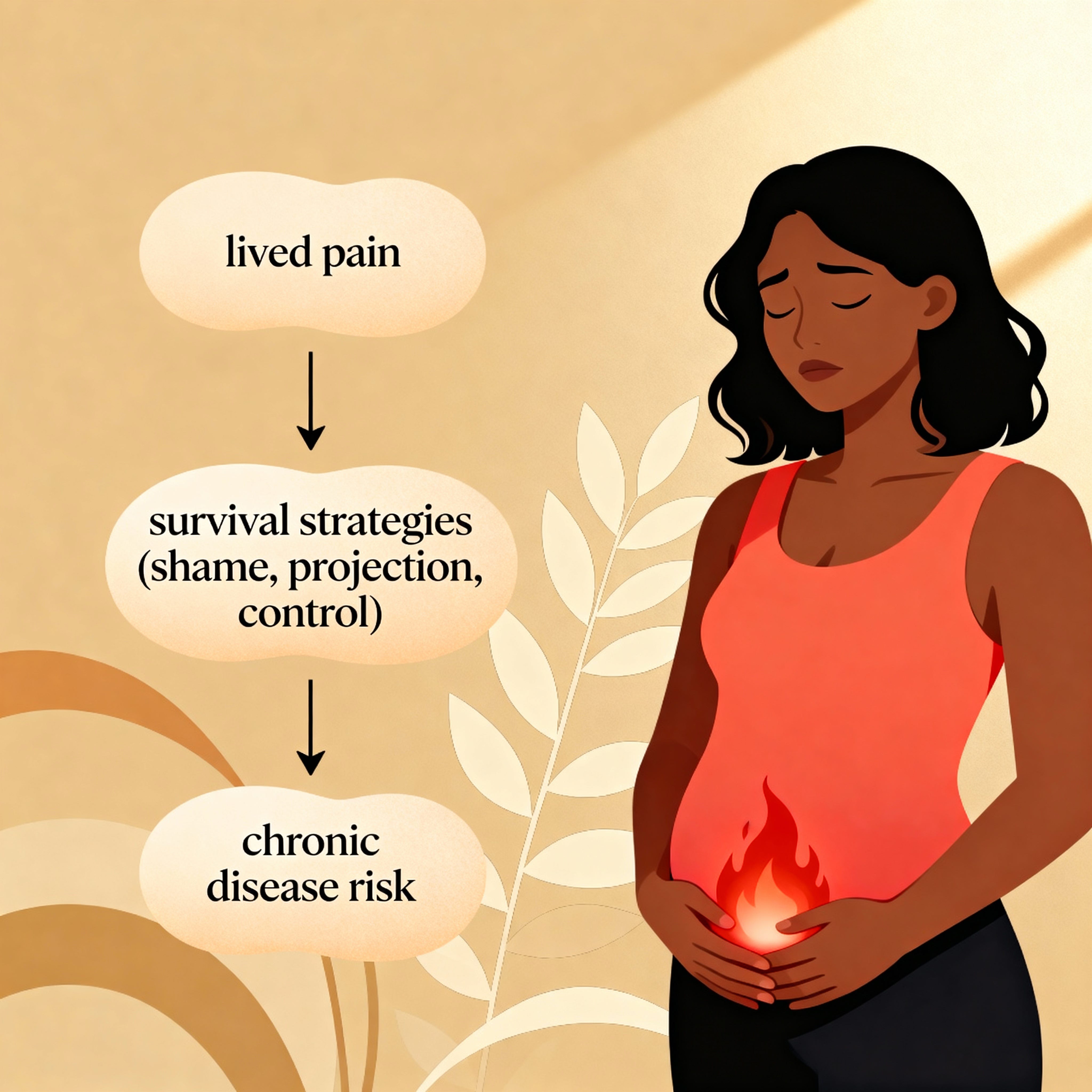
When we trace the chain outwards it looks like this: lived pain → survival strategy (shame, projection, control) → persistent stress biology → increased chronic disease risk. This system is especially visible in conditions that live in the pelvic/reproductive space, e.g. pelvic pain, endometriosis, heavy bleeding, fibroids, because reproductive tissue is tightly regulated by hormones, immune signals and metabolic state. Chronic activation of stress pathways changes oestrogen signalling, inflammation and tissue-level repair.
There’s ecological context, too. People hurt in social systems that either amplify or dampen threat. Communities under constant threat, whether from poverty, racism, or persistent social marginalisation, carry higher allostatic load: cumulative wear on the body from chronic stress. The “weathering” hypothesis summarises this: long-term social and economic disadvantage accelerates physiological decline, increasing the risk of multiple chronic conditions. That social load helps explain why some groups experience more severe or earlier-onset disease.
Add an intergenerational dimension and the story thickens. Dr Joy DeGruy’s Post-Traumatic Slave Syndrome (PTSS) describes how multi-generational trauma shapes behavioural patterns, relationship dynamics and health vulnerabilities. Epigenetic and behavioural pathways can transmit stress effects across generations as inherited risk that makes the body more reactive to threat unless consciously interrupted.
Outside formal medicine, mind-body teachers like Louise Hay provided accessible metaphors that helped people name painful interior patterns (e.g., “emotional causes” of illness). Her language is not scientific proof, but it gives clients a usable narrative to commit to change. When metaphor and measurement line up, as in story plus biochemistry, people are more likely to engage in the multi-layered work that actually alters biology.
The result is a vicious cultural loop: hurt people reproduce hurt because projecting pain onto others momentarily reduces personal threat. In-group policing; the often merciless policing of behaviour and appearance inside marginalised groups, is a survival manoeuvre. “Make the other person smaller and the overseer will overlook you” is a primitive calculus. It protects in the short term and damages in the long term both socially and biologically.
If you care about transformation rather than blame, this is liberating: what looks like moral failure is often a tractable pattern. If we can intervene where the pattern is maintained - the nervous system, daily rituals, social dynamics, and the stories people tell themselves, we can change the trajectory.
The reproductive/“womb” locus: why it matters
The reproductive system is highly stress-sensitive. Hormonal signalling, immune modulation and tissue repair are influenced by chronic stress and inflammatory states. Recent research has connected psychological distress and fibroid risk and even found stress-linked molecular signatures (microRNAs) in uterine tissue, suggesting psychosocial load plausibly interacts with biological pathways in the uterus. This can be viewed as an integrative frame: psychosocial environment is a meaningful player in a multifactorial disease process.
5 steps you can do today to shift biology and behaviour and stop the “hurt” cycle
Below are five tight, no-nonsense steps you can use yourself. These are practical, evidence-aligned, and designed for busy, high-achieving women who want measurable change.
1) Contain your nervous system
Chronic threat keeps your body in repair mode. Lowering baseline threat stops the cascade that feeds inflammation and tissue dysregulation.
Do this now:
• 2-minute paced breathing: inhale 4s, hold 1s, exhale 6–8s. Repeat 6 times.
• Micro-pause before reaction: when triggered, take one long, slow breath and count to 6 before replying.
• Ground for 60 seconds, stand, press feet into floor, notice 3 things you can hear.
Daily dose: 3 × 2-minute sessions.
2) Name the survival story
Shame-based meanings turn events into identity. Naming the story removes its power and creates choice.
Do this now:
• Journal prompt (5–8 minutes): “The rule I live by is _______. I learned it when _______.”
• Say it out loud, non-defensive: “I see I’ve been operating from _______.”
• Reframe with one evidential line: “That rule helped me survive, but it no longer serves my life/leadership.”
Daily dose: 1 short journaling session + 1 verbal check-in.
3) Pair meaning with body-first action
Story work without body care leaves biology unchanged. Small clinical and lifestyle moves change the terrain.
Do this now:
• Book a baseline with a practitioner if you have persistent symptoms (full-body bio-resonance scan, bloodwork, pelvic check etc.). Don’t wait.
• Reduce quick wins: swap one processed sugar snack for protein+veg; drink one extra glass of water/day.
• Add one 5–10 minute somatic practice: pelvic breathing (soft belly inhale, gentle pelvic tilt on exhale) or a guided pelvic-release video.
Daily dose: one nutrition swap + one somatic practice.
Note: these are supportive steps and are not medical treatment. Always see your doctor for medical advice and diagnoses.
4) Repair your social field
Ongoing social threat keeps stress levels on constant alert. Changing small relational patterns reduces ongoing biological load.
Do this now:
• Use a 15-second boundary script: “I can’t engage on that right now, let’s talk later.”
• One micro-ritual to interrupt policing: when gossip starts, say, “Is this helpful?” and pivot the conversation.
• Create one accountability contact: text one person weekly with a short update on one health or behavioural goal.
Daily dose: one boundary + one accountability check.
5) Layer lineage work, knowledge + ritual = agency
Understanding inherited patterns converts shame into strategy. Rituals rewire meaning in the nervous system.
Do this now:
• Three-line practice each morning: write one ancestral truth, one pattern you’ve inherited, one action you choose instead.
• Read one short piece on intergenerational stress or family health history (10–15 minutes).
• Do a 3-minute ancestor letter (write what you would say to the women before you) - keep it private or burn/ritualise safely.
Daily dose: three-line practice every morning.
How to use this quick plan
Pick one action from each step and do those five daily for two weeks. Track: energy, sleep, pain, impulse to react: one quick note each night. After 14 days, add another micro-action from any step.
Hurt people will keep hurting until someone gives them another script and a safer nervous system. That’s the work: rigorous, accountable interventions that rewire survival into sovereignty. Rather than being “therapy” or self-help fluff, you could call this public health if its done at scale. When you stop operating from chronic threat, you’ll stop reproducing systems that make everyone sicker.
References
Van der Kolk, Bessel A. The Body Keeps the Score: Brain, Mind, and Body in the Healing of Trauma. Viking/Penguin, 2014. (Colorado Mountain College)
Maté, Gabor. When the Body Says No: Exploring the Stress-Disease Connection. Wiley, 2003. (Dr. Gabor Maté)
O’Connor, TG; et al. “The neuroinflammation and psychoneuroimmunology literature.” Annual Research Review (PNI overview). (PMC)
Han, X.; et al. “Psychological distress and uterine fibroids: a bidirectional analysis / meta-analysis.” (2024). - review showing associations between chronic stress and fibroid risk. (PMC)
NIH / NICHD news: “Stress, microRNA linked to uterine fibroids, preliminary” (2024) - evidence of stress-related molecular signatures in fibroid tissue. (NICHD)
Geronimus, AT., et al. “The weathering hypothesis” (systematic review on accelerated health decline under social disadvantage). (PMC)
Academic review: “Racial Disparities in Uterine Fibroids and Endometriosis” - documentation of structural contributors, racism, and allostatic load in fibroid outcomes. (PMC)
DeGruy, Joy. Post-Traumatic Slave Syndrome: America’s Legacy of Enduring Injury and Healing. Joy DeGruy Publications, 2017. (SCIRP)
Hay, Louise L. You Can Heal Your Life. Hay House, various editions - foundational mind-body metaphors used in healing practice.