

Why Your Fibroids Keep Coming Back
The Hidden Metabolic Connection You Might Not Know About

The Frustrating “Wait and See” Approach
Let me see…
You’ve spent years dealing with heavy bleeding, the bone-deep fatigue of anaemia, and the literal weight of pelvic pressure, then you are well versed on the fibroid treadmill. It usually goes like this: your doctor finds several growths, tells you to monitor it, and when the symptoms become unbearable, suggests surgery. But then, a few years later, you’re right back in that same office, staring at a new ultrasound.
I want you to take a deep breath and hear me:
The Hidden Structure of Fibroids: What Most Women Are Never Told

When it comes to fibroids, most women are told the same thing: “They’re benign,” “They’re common,” “We don’t know what causes them,” or worse, “They’re incurable.” But what if the real issue and true nature of how and why they form is being overlooked entirely?
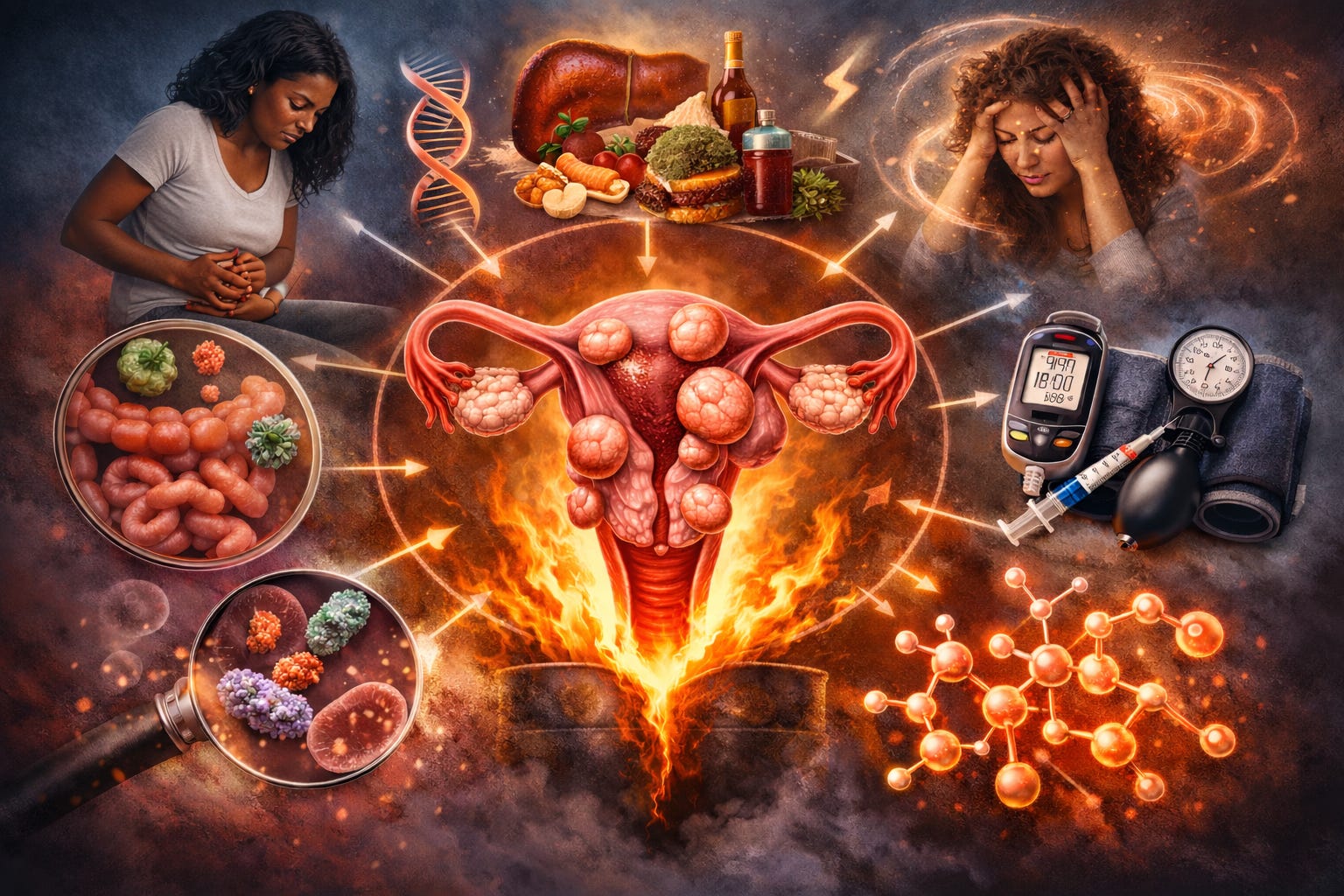
your fibroids are not the problem. Yes indeed. They are the smoke. Or better yet, they are the fire alarm. In our lovely medical system, they are very good at silencing the alarm by removing the fibroids, but they rarely look upstream at the fire itself. As in, what is causing the fibroids to grow in the first place. If the metabolic factors are not addressed, as in the environment that allows the fibroids to grow, your body is simply doing nothing more than what it’s being signalled to do: that is to grow more. Let’s look at the science of why this happens and how we can finally turn things around.
Understanding Your Body’s Natural Hormone Traffic Controller
To understand how fibroids grow, it’s important to understand your body’s most important hormone: Sex Hormone Binding Globulin or SHBG. SHBG is produced by your liver and acts like a sponge, absorbing excess hormones and parking them so they are less likely to cause trouble.
But SHBG has a biological bully called Insulin. You likely know Insulin as the hormone that manages your blood sugar, but in the liver, it wears a different hat. When insulin levels stay high (due to a diet high in processed food or high amounts of stress), it essentially tells the liver to stop making SHBG.
This leads to a hidden danger: Low SHBG = High Free Oestrogen. You might have a blood test that shows your oestrogen levels as “normal”, but if your SHBG levels are low, you have a massive amount of free or biologically active oestrogen circulating. This is the fuel that your uterine tissue is soaking up.
Why Fibroids are Like High-Sensitivity Hormone Antennas
Fibroids are uniquely hypersensitive to hormones. Think of normal uterine tissue as having a standard radio antenna, but a fibroid is like a massive, high-powered satellite dish.
Research shows that fibroid tissue contains significantly more receptors for oestrogen and progesterone than the healthy tissue surrounding it. These hormone receptors catch even the smallest signals to grow. When you have high levels of free, un-bound oestrogen circulating because your SHBG is low, these receptors catch every bit of it, translating that signal into rapid cell proliferation. So the growth rate of fibroids correlates directly to how much of that free, un-bound hormone is available in your system.
How Insulin Drives Fibroid Growth
While oestrogen usually gets the blame for fibroids, Insulin Resistance is often the mastermind working in the background. High insulin drives growth through three specific fertilizer effects:
It stops your liver from producing SHBG.
It turns on an enzyme called Aromatase, which acts like a factory, converting other hormones into even more oestrogen.
Insulin directly stimulates the cells in the fibroid to divide and multiply.
This is why you see such a massive overlap between Metabolic Syndrome: which is a cluster of conditions like high blood pressure and blood sugar and fibroid risk. The data is clear:
“Eleven other factors affected Uterine Fibroid risk to a magnitude similar to or greater than race. Age, premenopausal state, hypertension, family history... increased UF risk.” — Stewart et al., Epidemiology of Uterine Fibroids
In fact, women with hypertension have an almost fivefold increased risk of fibroids. Your blood pressure and blood sugar are part of the same metabolic fire fueling the growth in your uterus. They are not separate issues.
Why Cutting Them Out Isn’t a Permanent Fix
Surgery can be a lifesaver for immediate relief, but we have to recognise that this becomes our ‘Surgery Trap’. Clinical observations show that recurrence rates following a myomectomy are frustratingly high. The reason for this is clear: a surgeon can remove fibroids, but they cannot simply remove your metabolic environment.
If the conditions that create fibroids remain high in insulin and low in SHBG, your body is still receiving the growth command. It’s like pulling a weed but leaving the fertilizer-soaked soil behind. Without changing your internal environment, your body is essentially programmed to regrow what was taken. This is why approximately 25% of women with fibroids find their symptoms are severe enough to require repeated treatments.
The Silent Hero of Hormone Balance
Your liver is the engine of hormone health, and it performs a beautiful two-step dance to keep you balanced.
In Phase I, your liver unlocks and prepares used hormones and toxins for exit. In Phase II Detox, the liver packages up these toxins tightly so they can be sent to your gut for evacuation. If your liver is sluggish, perhaps due to a diet high in the food additives the Stewart study identifies as a 3.17x risk factor, the detox sequence breaks down. Used oestrogen ends up being recycled back into your bloodstream, adding more fuel fibroid growth.
How Your Gut Influences Your Uterus
The final step of hormone clearance happens in your gut. There is a specific colony of bacteria called the estrobolome that is responsible for making sure oestrogen actually leaves your body in your stool.
When you have Dysbiosis (an imbalance of gut bacteria), these bacteria produce an enzyme that un-packages the oestrogen your liver worked so hard to bundle up. This un-packaged oestrogen is then reabsorbed into your bloodstream. It’s a loop of prolonged exposure that keeps your levels high, even if your body is trying to get rid of it. That is why supporting your gut is just as vital as supporting your liver.
Shifting the Paradigm
Treating a fibroid while ignoring your metabolism is like walking into a burning kitchen and turning off the smoke detector because the noise is annoying. This is why it’s important to look beyond the treatment model where the uterus is looked at in isolation.
Your body is a Bodymind: an intelligent, interconnected network. As Dr. Candace Pert explains in Molecules of Emotion:
“The body and mind are one... [Our] biochemical messengers act with intelligence by communicating information, orchestrating a vast complex of conscious and unconscious activities at any one moment... This bodywide information network is ever changing and dynamic.”
A fibroid is a physical message in that network. It is your body’s way of communicating that something is out of sync.
The True Cost of the Quick Fix Mentality
When you only look for a quick fix, you ignore the escalating costs to your health:
Short-term: Repeated invasive surgeries, the constant drag of anaemia-driven fatigue, and the anxiety of wondering when the symptoms will return.
Long-term: Ignoring the insulin connection increases the risk of Type 2 Diabetes and non-alcoholic fatty liver (NAFLD). Furthermore, the Stewart study shows that women aged 41–60 have a tenfold increased risk of fibroids. If you don’t fix your metabolism, the transition into perimenopause can become a hormonal storm.
A New Way Forward
Research shows us that while factors like race (a 2-3x risk) and family history play a role, we have incredible power over our body. To stop the cycle, its super important address the Mastermind factors:
Watch the Additives. Processed food additives are linked to a 3.17x higher risk.Anti-inflammatory foods are key.
Rethink Soya. The Stewart study noted soybean milk consumption as a 2.52x risk factor.
Manage the Pressure. High blood pressure is a massive metabolic red flag.
Support your liver. Give your liver and gut the nutrients they need for Phase II Detox.
If you have fibroids, that is your body telling you something is off. Are you ready to stop silencing the alarm and start putting out the fire?
If you found this powerful, here are three more articles you can explore next:
• The Lymphatic System’s Hidden Role in Fibroid Growth
• Fibroids: The Unexplored Meaning
• Why Every Woman with Fibroids Needs a Proper Assessment First
This space is where I teach the real truths about fibroids, womb health, and healing: the things women are never told. Stay connected as I continue to share the frameworks, insights, and root‑cause teachings that shape my work.