

Why Your Iron Pills Aren't Working
The Hepcidin Gatekeeper and the Legacy of the Tired Woman

The Lead Balloon Feeling: Walking Through Waist-Deep Water
Let me show you what Iron Deficiency actually feels like. So yes, you are tired all the time, but it’s so much more than that. It’s like you are walking through waist-deep water with a lead balloon strapped to your waist while everyone else is strolling on dry land.
It’s the heart palpitations that hit you the moment you try to climb a single flight of stairs, as if your heart is screaming for oxygen it can’t quite get. It’s the pure exhaustion that turns basic tasks into Herculean efforts. And then there’s the brain fog, the kind that makes you stand in the middle of a room, trying to remember the word for spatula, while your mind struggles with the most basic words.
For me, it was a life sentence I didn’t know I had signed up for.
I remember being in a classroom at school. The teacher was telling us about boys and girls’ reproductive systems. Of course, we were all embarrassed, so there were nervous giggles. The teacher was discussing body parts, a subject that always made us squirm. Then, she dropped a fact that I remember to this very day. She said that throughout your entire menstrual cycle, you are only supposed to lose about half an eggcup of blood.
My immediate internal reaction was pure cynicism. “Yeah, right!” That was my exact thought.
It wasn’t true for me. I was losing so much more than that. But, it was normal. No one had told me otherwise. My mum never mentioned what to expect as I grew into a woman, and I was as naive as they come. I assumed my heavy bleeding was just how it was, and get this… I also thought women had periods all day everyday for the rest of their lives. I remember thinking “how does this make sex possible?”
I spent my childhood and young adulthood not having basic questions about my body or life in general never being answered, so I thought it was ‘normal’ to bleed a lot. I had no idea that I was literally haemorrhaging.
The normalisation of fatigue is a legacy we’ve inherited, but It’s a physiological problem with a specific, solvable cause, and understanding that starts with meeting the gatekeeper.
Meet Hepcidin: Your Body’s Iron Traffic Controller
If you imagine your body as a city, hepcidin would be the overzealous traffic controller standing at the only bridge in and out.
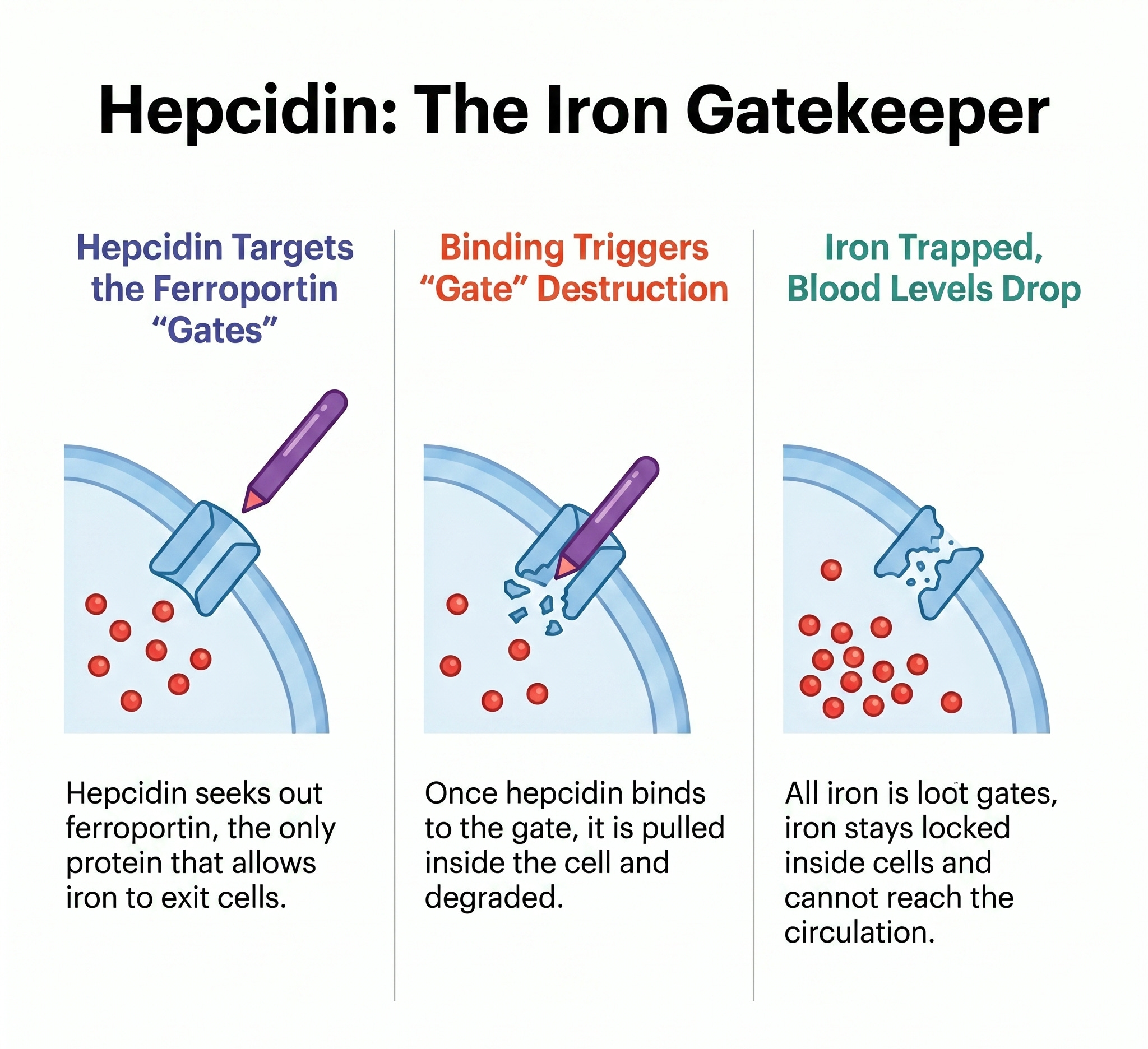
In a healthy system, this controller would normally do a great job by keeping traffic flowing smoothly, letting iron in when it was needed and holding it back when it wasn’t. But when your body is under ‘attack’, be it from large fibroids, chronic stress, or high-oestrogen, it goes into panic mode. Your liver then starts pumping out more hepcidin, which floods your entire system.
The role of hepcidin’s in this ‘alarmed’ state is to slam the gates shut.
It literally blocks iron from leaving your gut and entering your bloodstream. Imagine standing at a locked door, screaming for help, while a bucket of iron pills sits uselessly on the floor behind you. If your hepcidin levels are sky-high, you could swallow a bucket of those pills, and they would just sit in your gut, fermenting and causing constipation, without ever reaching your blood.
When your body senses inflammation, infection, or even the possibility of trouble, it does something incredibly clever. It hides the iron.
Iron is rocket fuel for bacteria. They cannot multiply without it. So your immune system locks it away inside proteins like transferrin and ferritin. This is called nutritional immunity, and it’s one of the oldest defence strategies we have. Amazing right?
But the only issue is that your body can’t tell the difference between I’m bleeding heavily every month and I’m fighting an infection. So it keeps the gates shut, even when you desperately need the iron.
This is why just being prescribed iron pills fails so spectacularly. It’s like trying to fill a bathtub with the drain plugged and the tap (faucet) turned off. Essentially, your body is actively preventing iron from entering because it’s in a state of inflammation.
Your body is never ever doing anything to harm you. Heavy menstrual bleeding drains your iron stores plus it creates inflammation in the uterus. And inflammation is the exact signal that tells your liver to raise hepcidin and lock the gates. In fact, your body is doing its best to protect you, although it might not feel like it! Iron feeds bacteria and fuels inflammation, so in times of stress, your body will keep the doors firmly locked to keep the peace. But in doing so, it leaves you anaemic, exhausted, and brain fogged.
Understanding this mechanism changes everything. It means everything you are experiencing, from fatigue to constipation is a signal that the gates are locked, and you now need to find the key to open them.
The Evidence-Based Fix: The CEO Strategy
If you treat your body like a broken car, you just ask for a mechanic who changes the oil and hopes the engine starts. But if you treat your body like a high-performance machine, you need a proper protocol. A triage. It’s the CEO approach to your health: gather the data, optimise the supply chain, and remove the bottlenecks.
So let me give you the blueprint so you can to stop guessing and start fixing yourself at the root level:
Step 1: Test, Don’t Guess
Now I just know you’ve heard this before, and perhaps you have been tested loads of times. However, there is much more to it.
Most of us would perhaps just get a standard blood test that checks Haemoglobin. This tells you how much oxygen is currently being carried in your blood. It’s like checking the fuel gauge in your car’s tank. If the needle is low, you know you’re running on empty.
But Haemoglobin doesn’t give you the complete picture. It doesn’t tell you about your Ferritin.
Think of Ferritin as your storage tank. It’s the reserve fuel you have in the underground silo. When you are truly iron deficient like I was, your tank is completely empty, even if your car is still running on the last few drops of fuel in the pipes (Haemoglobin). You can be normal on Haemoglobin but critically low on Ferritin.
And the biggest missing piece in all this is inflammation.
Before you take another pill, ask for a CRP (C-Reactive Protein) test, if it has not already been included, and the same with Ferritin. CRP is to check for systemic inflammation that triggers the hepcidin lockdown. If your CRP is high, your hepcidin is likely to be high, and your iron pills are just going to sit in your gut. You need to know if the gates are locked before you try to force them open.
Just be aware, that if you have had a Full Blood Count (FBC) and it includes everything including the two biomarkers Ferritin and CRP, and your reading is ‘normal’, your best bet is to have someone interpret those results for you (I can do this). Just because you fall into the ‘normal’ range does not mean normal if you are still feeling pants.
Step 2: The Absorption Window
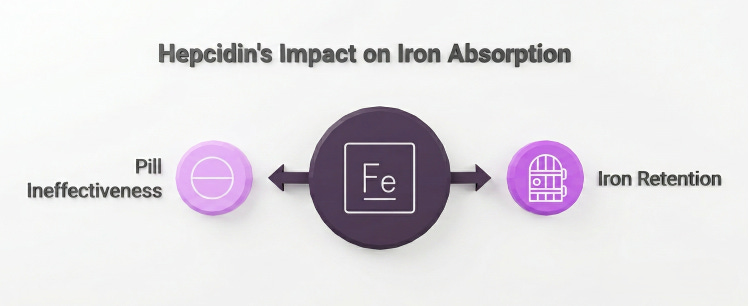
If the gates are locked by high hepcidin, taking iron every single day is, well, totally useless. I really wish I had this knowledge back then…
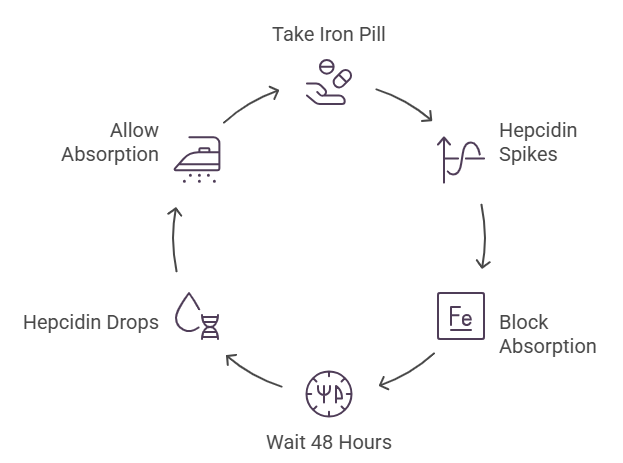
Throwing iron pills down your neck everyday creates a constant spike in hepcidin. Hepcidin spikes for about 24 hours after you take iron. If you take another pill the next day, you’re swallowing it into a locked system. Your body sees the iron, panics, slams the gates shut, and blocks absorption. It’s a vicious cycle.
However, the science points to a smarter strategy don’t you know! It’s called Alternate Day Dosing.
These studies suggest that if you take your iron pills every other day, approximately every 48 hours, allows your hepcidin levels to drop back down between doses. This then opens the absorption window, giving your body a chance to actually let the iron in when you do take it. So, instead of fighting your biology every 24 hours, you’re working with your body’s cycle. Now doesn’t that sound more calming, than trying to force your body to do something? It might sound counter-intuitive to take less, but it’s the only way to make the iron actually work.
Step 3: Anti-Inflammatory Support
Step away from the sugar! Lowering inflammation is the best iron strategy out there.
Your body produces hepcidin because it thinks it’s under attack (from fibroids, stress, gut issues etc.), but if you are able to lower that inflammation, you lower the hepcidin. When hepcidin drops, the gates open. Yay!
This means your iron protocol is about:
* Gut Health: Healing your gut lining so absorption is efficient.
* Antioxidants: Reducing the oxidative stress that fuels inflammation.
* Lifestyle: Managing your stress and high-oestrogen states that trigger the lock.
Basically, you are building an environment where iron can be absorbed, rather than just throwing more iron at a problem.
The Generational Shift: The New Blueprint
Why does this matter so much? It’s easy to think that understanding hepcidin and ferritin is just about getting your energy back so you can return to work or keep up with the kids. So Indeed! Feeling better is the immediate win.
But this is about something sooo much bigger. I am talking about the Generational Shift.
What the heck is that?
When you understand the hepcidin gatekeeper, you stop blaming yourself for failing or not trying hard enough, and you stop internalising the shame of chronic fatigue.
Instead, you start treating your biology with the precision it deserves, and you now realise that fatigue is a physiological data point. It’s telling you something. Your body is shouting for attention. The day I learned about hepcidin was the day everything clicked. My own beautifully designed body that I used to punish and beat up, was protecting me in the only way it knew how. And once I understood the mechanism, I finally knew how to work with my body instead of fighting it. My body was saying “The gates are locked, and I’m starving. Please help me out here.”
Can you imagine how differently we would treat our body, if we started teaching our daughters, nieces and other young ladies that fatigue is a sign to check what your body is needing rather than just suppress it with medication? Imagine a generation of girls who know to ask for a CRP test before being fobbed off with iron pills or birth control.
When you understand your biology, the entire healthcare conversation changes, not just for you, but for every girl who comes after you.
The Great Pivot: From Fighting to Partnering
Another layer is how you relate to your own body.
Right now, far too many women are in a constant state of war with our biology. We are literally battling with it. We fight fatigue. We fight heavy bleeding. We fight brain fog, cursing ourselves for not being on it enough. If you think about it, like you I was taught to go to battle with my body and treat it like a broken machine that needed to be forced into submission.
It took many years to realise this, but your body is not and has never been your enemy.
Even when it feels like it’s fighting against you, your body is at all times, actually trying to protect you. So the lock on your iron stores is nothing more than a defence mechanism. It’s no different from a wild animal that will attack you if you go anywhere near its young, even if you mean it no harm. And the exhaustion you get is an energy conservation strategy. Your body is doing its best to keep you alive in a state of chronic inflammation or stress.
When you understand that your body is always protecting you, it changes the relationship you have with yourself. You might start giving it a little less of a hard time. You might stop fighting the symptoms and start listening to what your body actually needs.
Take this as your new blueprint: Understand your body, little by little.
When you stop fighting and start partnering with your biology, you become your own best advocate.
Now…
Go unlock those gates. Your energy is waiting on the other side.
You now know that your body isn’t failing to absorb iron and it’s trying to protect you from inflammation. You understand that hepcidin is the gatekeeper, and that the standard take a pill advice is not necessarily the best way to go about resolving this issue.
But knowledge is only the first step. The real work begins when you turn that understanding into action.
Now is the time to stop guessing.
I invite you to take the Uterine Health Audit. This isn’t a medical diagnosis, and it won’t replace your doctor. Think of it as a non-diagnostic compass. Its the first step in helping you discover what is going on in your body.
It’s designed to help you:
* Identify the patterns you’ve been ignoring.
* Connect the dots between your symptoms and your biology.
* Walk into your next medical appointment with clarity.
* Start understanding your body’s unique language before you swallow another pill.
This is your first step toward taking back control. There is no need to navigate this alone, and you certainly don’t have to accept normal when it feels like anything but.
Take the Uterine Health Audit here.