

Why Your Liver Holds the Key to Shrinking Fibroids
Beyond the Mysterious Growth Myth

Conventional medicine has left millions of women in watchful waiting mode, treating uterine fibroids as if they’re just a problem with your womb. You’ve probably been told these growths are down to being Black or having the wrong genes, leaving you facing surgery or medication as your only real options. But what if we stopped focusing on the fibroid itself and started asking why your body is getting signals to grow them in the first place?
Picture us sitting down for a proper chat, and I tell you something that might surprise you: the biggest influence on your hormone imbalances isn’t actually your womb at all, it’s your liver. While everyone else is obsessing over shrinking fibroids, the real story is happening in your liver, your body’s main detox organ. Your liver is the one deciding which type of oestrogen ends up in your bloodstream, and which type gets permission to fuel fibroid growth.
The truth is, it’s less about having too much oestrogen, and more about how your liver chooses to break it down.
The Tale of Two Pathways: The Protector vs. The Grower
When your liver processes oestrogen (specifically estrone) during what’s called Phase I detoxification, it comes to a fork in the road. Through a process called hydroxylation, your liver uses something called the Cytochrome P450 enzyme system to send oestrogen down two very different paths. One path protects your tissues, while the other acts like fertiliser for fibroid growth.
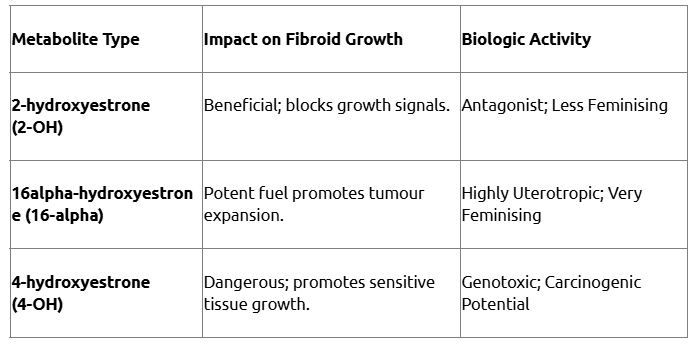
The Protective Path creates something called 2-hydroxyestrone (2-OH for short). Think of this as the gentle version of oestrogen. It’s less feminising and actually acts as a natural blocker. It sits on your oestrogen receptors like a placeholder, stopping the more aggressive, growth-stimulating oestrogens from reaching your uterine tissue. It’s your body’s built-in safety mechanism.
The Growth Path, on the other hand, produces 16alpha-hydroxyestrone (16alpha-OH). Medical research describes this metabolite as highly uterotropic, which is a fancy way of saying it really loves your uterus. This version forms an incredibly strong bond with receptors and sends a loud, clear message to your smooth muscle cells: multiply. There’s also a third troublemaker called 4-hydroxyestrone (4-OH), which can actually damage your DNA, making the cellular environment even more complicated.
Oestrogen Metabolite Comparison
Why Your Body Keeps Choosing the Growth Path
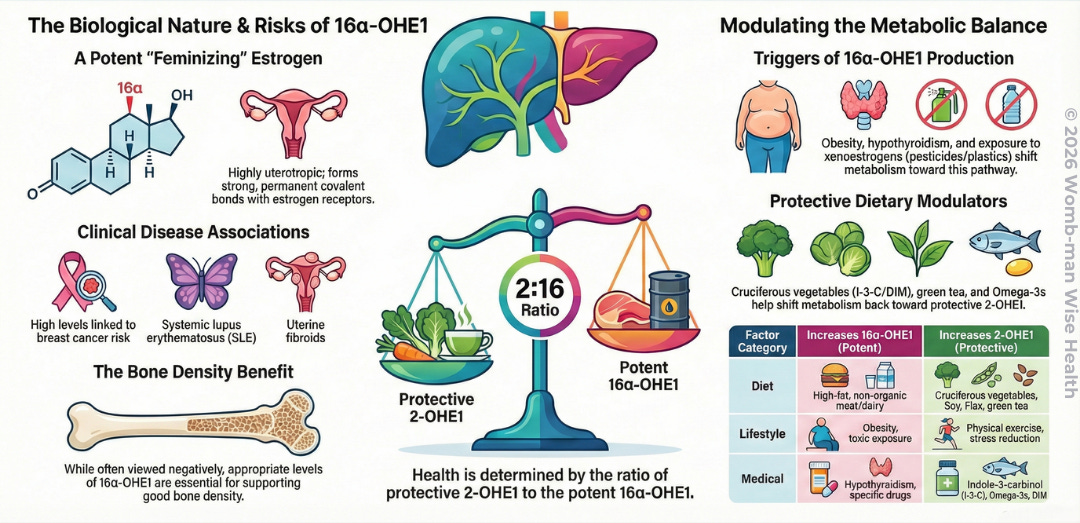
Your liver doesn’t deliberately choose the growth path because it’s responding to specific environmental and metabolic triggers that are pushing it in that direction. Let’s call these Ratio Reducers because they shift your system away from the protective 2-OH pathway and toward the aggressive 16-alpha pathway.
Visceral Fat and the Vicious Cycle: Belly fat is actually an active hormone-producing organ. It contains an enzyme called aromatase that converts male hormones (androgens) into oestrogen. This creates a dangerous feedback loop: inflammation triggers aromatase to make more oestrogen, which then creates more inflammation, which makes even more oestrogen, and round and round it goes.
The Gluten Connection: Gluten can suppress an important enzyme called Cytochrome P450 3A4. This enzyme is a key player in the protective metabolism pathway, so when it’s suppressed, you end up with oestrogen dominance and a reduced ability to clear those growth-promoting metabolites.
Sluggish Thyroid: Low thyroid function (hypothyroidism) is a well-known trigger that tips the balance away from the protective 2-OH pathway and toward the potent growth metabolites that feed fibroid tissue.
Environmental Hormone Disruptors: Pesticides, plastics (like BPA and phthalates), and dioxins are what we call xenoestrogens, fake oestrogens that your body mistakes for the real thing. They interfere with your Cytochrome P450 system and add to the total oestrogen load your liver has to deal with.
The Gut Problem: When Your Body Recycles Oestrogen
After Phase I processing, your liver moves to Phase II, called conjugation. Think of this like your liver putting oestrogen in a package - it attaches a molecule (like glucuronic acid) to the oestrogen, essentially handcuffing it so it becomes water-soluble and ready for removal. This packaging is supposed to ensure that oestrogen leaves your body through bile and your intestines in what’s known as Phase III (Elimination).
But… if your gut bacteria are out of balance (what we call dysbiosis), the whole process gets sabotaged. In a compromised gut, certain bacteria produce an enzyme called beta-glucuronidase, which acts like molecular scissors. It cuts off those handcuffs—the packaging your liver carefully placed on the oestrogen. Once freed, the oestrogen is no longer heading for the exit. Instead, it gets reabsorbed back into your bloodstream through something called enterohepatic recirculation, constantly bathing your fibroids in recycled growth signals.
How to Influence Your Liver’s Choice
The good news is you can shift the chemical environment that allows fibroids to thrive. You have real power to influence your liver’s metabolic choices through targeted dietary and lifestyle changes.
Cruciferous Vegetables: Compounds like Indole-3-carbinol (I-3-C) and Diindolylmethane (DIM) found in broccoli, kale, and other cruciferous vegetables actually modify your P450 enzyme activity to favour that protective 2-OH pathway.
Green Tea: The main active compound in green tea, EGCG, has been shown in research to significantly reduce fibroid volume and improve quality of life.
Fibre is Non-Negotiable: Fibre is essential for Phase III (Elimination). It acts like a physical sponge in your gut, soaking up those metabolites to prevent them from being reabsorbed. As a bonus, it also increases your Sex Hormone-Binding Globulin (SHBG) levels, which helps keep oestrogen in check.
Go Organic: Choosing organic, hormone-free meat and dairy matters because xenoestrogens concentrate in the fat of conventionally raised animals. You don’t want to add to your oestrogen burden.
Plant-Based Oestrogen Modulators: Specific compounds like flaxseed lignans, resveratrol, hops flavonoids, and black cohosh can help modulate your oestrogenic environment more safely and gently.
Fibroids Are Your Body’s Alarm System
We need to stop viewing fibroids as just a female problem and start seeing them as your body’s alarm system, a signal that something systemic is out of balance. For instance, high insulin levels are a major driver of fibroid growth. Insulin stimulates that aromatase enzyme we talked about earlier and decreases SHBG. When SHBG is low, more oestrogen is free and active in your bloodstream, ready to bind to fibroid receptors.
There’s also Vitamin D, which acts as a master controller, regulating sex steroid receptor expression directly within fibroid tissue. And we can’t assume progesterone is always the solution. Research shows that while Progesterone Receptor B (PRB) can reduce inflammation, Progesterone Receptor A (PRA) can actually increase it. In an unbalanced environment, progesterone can even increase the blood supply and size of a fibroid.
Become Your Own Investigator
If you’re dealing with fibroids, it’s time to shift your mindset from sufferer to investigator. You’re not a victim of some mysterious growth. Your body is responding to specific chemical and environmental imbalances that you can identify and address.
Further, standard liver tests like AST and ALT only measure liver cell damage. They often completely miss the functional detoxification errors that are actually fuelling fibroid growth. Consider looking into Functional Detoxification Testing or Organic Acid Testing* to see your unique metabolite ratios and how well your COMT and P450 enzymes are working.
Your body isn’t failing you—it never has. It’s responding to a chemical environment that you now have the tools to change. By supporting your liver’s traffic control functions and quieting those systemic growth signals, you can begin to genuinely reclaim your hormonal health.
* Contact me directly for these tests.
If you enjoyed reading this article, you’ll really like these:
Why Your Natural Fibroid Remedies Aren’t Working
Fibroids: Are They Really Dangerous
This space is where I teach the real truths about fibroids, womb health, and healing: the things women are never told. Stay connected as I continue to share the frameworks, insights, and root‑cause teachings that shape my work.
No worries. I’m finally ok. It just turned out that I had a ruptured fibroid. I’m 5 years post menopause so the bleeding was quite unnerving. I had an ultrasound done just to make sure nothing life threatening was going on. I have an appointment with the one woman in my city who I could find (not in my insurance of course) who has taken more courses than a doctor would in menopause. She’s the person I need to talk to. I was pretty desperate when I wrote that. I was exhausted, feeling crappy and frustrated. I’m good now.
Thank you for responding. ❤️
Help.